As has been lamented in numerous places big budget movies especially the Superhero franchises seem to be getting somewhat stale. They lack new and original plots, focus to much on visual effects, need to cater to too broad of an audience spectrum, are too much of an investment to take any "risks" etcetera. The thing that has been bothering me the most lately was a particular trope that is not just lame and overdone, it is also particularly concerning considering our global political climate at the moment. That is the portal to the evil other dimension.
The plot of seemingly every other Superhero movie these days is that some ill-advised human opens a portal to an evil other dimension that threatens to bring chaos, suffering and death to all of humanity. Then, of course, it is up to our heroes to basically plug that hole and keep the evil other out. Even if, in the theatre, we may be too bedazzled by special effects and funny banter to realize how problematic that is. The recap should give us pause. Because we are inundated with this narrative not only in our Superhero franchises but also in the news. Name the ill-advised human Angela Merkel for example and the evil other dimension the so called Arab world and you suddenly you are not in your fun-escapist-special-effects-fest anymore. Suddenly you find yourself in the midst of our current real-life drama where blocking the Balkan route and building a wall to Mexico are on actual political agendas. The problem is that in real life things are not all so neatly black and white and solutions are not so easy.
Most of Hollywood does like to show itself rather more progressive in their politics. Many actors, directors and writers advocate for refugee aid, compassion and more inclusive politics. And yet, when it comes to their own back yard and their biggest influence - the cultural narratives they shape with their storytelling - they irresponsibly draw draw on tropes like this. They perpetuate narratives where evil nature of that other dimension and the beings within it are never even questioned, where there is never any real engagement with the other side or attempts at understanding. Our heroes don't even try. They don't communicate with the other, they communicate at it, usually in a rather aggressive and threatening manner. They attack and they kill. No questions asked. And, as last seen in Doctor Strange, they better not let any aspect of the other side contaminate our world. We as the audience are lead to buy into these foregone conclusions and we get manipulated to believe in the need to close up that portal. So when we return to our own world why would we not seek some equally easy answer to our own problems. Why would we not look for a "hero" to close our portal for us, or build us a wall ...
Sure, we are not going to solve all the world's problems with better movies. The real world is more complex than that. There are always many other factors at play. But everyone needs to do what they can and I think it is time Hollywood put their narratives and their budgets where their mouths are and reconsidered some of the messages they are putting into the world. Story is a tool to be used wisely for it can do a lot of good but it can also do a whole lot of harm. We should not forget that and be responsible about what we put into the world. Maybe we can avoid harm, maybe we can even inspire change and adjust failures of imagination. Fiction is known to have done so before.
Showing posts with label Social Issues. Show all posts
Showing posts with label Social Issues. Show all posts

August 22, 2016
Olympics: Benign Patriotic Fun or Destructive Potential
True, that is not an entirely new development. Since their inception, the modern Olympic Games have been all about - as John Oliver put it so nicely - finding out
"who is better than everyone else, so that we can make them stand higher than the other people who are not as good as them. Because the point of the Games is not to celebrate equality. It is to celebrate individuals' excellence."That already sounds much closer to reality than the official rhetoric. However, is it really about individuals' excellence? Considering how the whole thing is set up, how the commentary goes, and what the audience cares about, it should be fairly obvious that the athletes as individuals are actually a secondary concern. They are not competing as individuals so much as as representatives of their respective countries. Both the commentators and the audience seem much more concerned with the medal count than even with the disciplines the medals are won in - much less individual athlete's achievements. Patriotism is very much embraced and encouraged. After all what is so wrong about a little patriotism?
Well, if you think about it, quite a lot actually. For one thing, patriotism is essentially irreconcilable with the Olympic idea as it stands. It divides people and fosters an Us-vs.-Them-Mentality that can be - and has historically been - utilized to both distract people from internal problems and reinforce enemy stereotypes. Clearly that supposedly harmless bit of patriotic fun carries quite a bit of destructive potential. Not to mention that divisions along national lines keep us from addressing global problems we are all facing together. Problems that are very much driving nationalistic moods around the globe.
These moods and attitudes are in turn fed by things like broadcasting choices and commentary of the Olympics (or other international sports events) and, of course, the news media, which very much imply and teach something like a hierarchy of care. We all know and expect that any kind of event that effects the western world and particularly our own country is going to get quite a different kind of coverage than anything that effects people we identify much less with. I can't help the anger boiling up inside every time they inevitably start any report of international events by establishing whether or not Germans were affected. And of course, what works on the global scale also works for internal affairs, as exemplified by the difference between reports about people attacking refugees and their accommodations vs. reports about refugees' and immigrants' misconducts, criminal activity, and potential danger to society.
Shouldn't we have learned by now that such discrimination has a strong potential to drive either party to their worst? Wouldn't we benefit from less self centred reporting? Maybe we can not get invested in everything that happens around the globe and neither should we, but a blind man with a stick should have seen by now that our modus operandi has not been doing us many favours - especially in about the last couple of hundred years. We all have neglected issues that we should have addressed and instead gotten involved in things we should have kept out of. Thus we have fostered and escalated conflicts at home and abroad that are now coming around to bite us.
And yet we never seem to learn. We go right back to our nationalist thinking. We don't even acknowledge that we might carry some responsibility for developments that are inconveniencing us now. And we refuse to even entertain practical solutions and solutions that favour long term benefits over short term profits. We distract ourselves with medal counts and the seemingly benign patriotic fun that events like the Olympics offer. Bread and Circuses. Business as usual.
May 8, 2015
On Caitlin Doughty's Smoke Gets in Your Eyes and My Struggle with Mortality
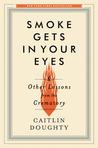 Smoke Gets in Your Eyes: And Other Lessons from the Crematory by Caitlin Doughty
My rating: 5 of 5 stars
Amazing! Fascinating. Thought Provoking. Moving. And so very Necessary. I think the fact that it took me a couple of weeks to even get up the courage and watch an Ask a Mortician Youtube video says a lot about how much I needed this book.
I vividly remember the very moment I realized that we are all gonna die some day and how I immediatly wished to unknow this again. Of course this is the kind of thing you can never unknow again. And thus I have been struggling with mortality ever since my kindergarten days - having panic attacks on a semi-regular basis. And I waited for a good day – a day I would be able to handle these videos without plunging into another panic attack. I need not have been so worried. In fact, I could have spared myself a lot of anguish had I just gotten up the courage to look sooner. Because as it turns out the only thing that really helps with the things that you can not unknow is to know more.
And yet the approach the western world in general and - as Caitlin Doughty illustrates - america in particular takes is quite the opposite. We do everything in our power to avoid any confrontation with death. We avoid talking about it as much as possible. We hide dead bodies off stage behind the curtain. We even try to find the “cure” for it. As a history student I am well aware how bizarre it is that I managed to be alive for almost 29 years without ever having seen a dead person – even though I have been to more funerals than weddings. But the thing is, in Germany, too, these things are more like memorials nowadays. There is no dead body at a funeral anymore – only a closed coffin or an urn. And nothing actually gets buried.
So death in effect has been reduced to the absence of a person in our lives as opposed to the absence of life in a body. Without this book it never would have occurred to me how much of a difference this little distinction makes. Now I see how grossly I have misinterpreted the myth of Orpheus and Eurydice and how much we have become like the petty gods of the Iliad. I am serious. When you really think about it you'll have to admit that people in modern western societies have a lot more in common with the gods in that story than with the humans. That is because we seem to think ourselves at least potentially immortal. So deeply are we in denial about our own mortality. Yet we still die. And every time we do we experience it as essentially unnatural. Death is not part of our life. It is a glitch. We don't see it as something that needs to be accepted, but as something that needs to be fixed.
Smoke Gets in Your Eyes is the account of Caitlin Doughty's own journey towards an understanding of death and how contemporary America and by extension western societies chose to deal with it. She shows how flawed and unhealthy these attitudes really are, how they evolved alongside the rise of the funeral industry and our euphoria in face of the great advances in public health and medicine, and how we would profit from a more realistic understanding of and engagement with death. I very am glad that I got to vicariously experience this journey through the guidance of her kind and witty words. I laughed and I cried (did not have a panic attack) and I think it is fair to say that this book changed my life.
View all my reviews
June 29, 2014
Me and Mrs. Dalloway
 Mrs. Dalloway by Virginia Woolf
My rating: 3 of 5 stars
I have got to say up front that Mrs. Dalloway put me through the most difficult reading process I ever made it through (and I have read a lot of academic texts, Egyptian tomb inscriptions and stuff). That was not because it is a bad book. It is because Mrs. Dalloway is not so much a book in the conventional sense with plot and such. It is basically a herd of consciousnesses invading your mind and running rampant. It is often hard to follow whose head you just switched into. It is somewhat like what I imagine being a mind reader must feel like. It's so utterly exhausting; like you wouldn't believe. I had to stop and take a break about every 30 pages and re-motivate myself to move on.
But while it was painful and hard to get through, it was also very rewarding and worth the effort in the end. It is hard to believe that this was first published in 1925. I mean, for example, how could this women so accurately (from what I understand at least) describe PTSD and recognize it as the serious illness that it is - long before it even became a diagnosis? And how come that it took the medical community so much longer to come to that same conclusion? (Their arrogance again and again their stupid arrogance. Like Woolf rightly recognized. And most infuriatingly still, they just don't learn from that mistake ever, it seems. Not from this. Not from the whole “gentlemen's-hands” debacle. Never. But I digress.)
All that would have been remarkable enough on it's own, but that is actually not the only issue she is surprisingly spot on about – again especially considering when this was written. She manages to step into the heads of all these characters and accurately portray them; young and old, male and female, everyone unique and life-like (i.e. with real issues); it's baffling. It makes me wonder if my paranoia about some people maybe being able to read my thoughts might have been justified after all …
View all my reviews
August 14, 2013
On John Green's Latest Video
In his latest video John Green talks about the just-world fallacy and that apparently whoever has an advantage isn't only prone to fall victim to it, but will also behave in pretty much the same way. Which makes him question the concept of power and whether or not someone in power is actually wielding it or wielded by it. Now there is undeniably some truth in there, but the problem with this short and oversimplified way of presenting it, is that it leads to possible misconceptions. For one thing, the reception of study results and the validity of statistics is a can of worms that I'm not even gonna open up here.
The thing I'd like to suggest is rather that the concept of anyone wielding power is actually more of an illusion, because nobody can ever achieve or even hold any level of power all on his own. It always takes the support of a whole bunch of other people and organizations, who in turn need people and organizations to provide their power. The thing is, these structures are not as linear as you might think, but complex and interconnected. They are a whole network of relationships. Power, then, is not anything that can be wielded by any one person or organization. I'd say it's rather a complex global system of interests that does provide different limits and obligations for everyone involved. Power therefore is almost as unpredictable a machinery as the weather. One thing is for certain, however, that change from top down is something that just doesn't really happen. Even if it might appear like it's coming from the top down, it has always been spurred by mechanisms that go much deeper and involve a number of elements to support it.
Now this might be disheartening for some people and make them believe that it doesn't really matter who is on top, but that is actually not the case. While any specific person might not be all that significant, the network of connections and interests behind them actually do matter a great deal. That is why, when voting in an election, knowing the supporters of any given party or candidate will probably be a much better indication of their agenda, than their promises or personal conduct.
As to how one might enact change in this system, I'd say you'd have to create a sufficient level of interest. That naturally has a lot to do with money. But that doesn't mean you necessarily have to be rich in order to change the world. Rather, I'd say, that if you manage to spread an idea far enough, it will gain monetary interest all on it's own. And spreading ideas today is much easier than it has ever been. The Internet provides so many tools for you to make yourself heard and to inform people in so many different ways. Whether you're better at expressing yourself verbally, artistically or in writing, you can easily and with minimal expenses make a difference and/or help others to do so. This is what makes me rather hopeful for the future. I'd like to believe that focusing on all the little things you can do, will in the end make much more of a difference, than rallying against the things that you really can't change.
Subscribe to:
Posts (Atom)