Pages

Showing posts with label Book Thoughts. Show all posts

November 1, 2015

How a Feminist Icon Fell From Grace or Vagina: A Book Review

Vagina: A New BiographyVagina: A New Biography by Naomi Wolf

My rating: 1 of 5 stars


Oh dear … in short: this book did not just fail to live up to my expectations, it made me very angry. That is because it is one of these frustrating texts that, while they claim to present an objective – even scientific – argument, are actually all about some personal issue of the author. In this case we have some weird hybrid of evangelist text, (pseudo-)scientific pamphlet and polemic against second wave feminism. What? Why? Huh? Well, when Wolf had a sexual crisis, she prayed to whatever god would listen, modern medicine answered her call, and revealed to her the poorly understood connections between the female sexual organs and the brain via pelvic nerve structures which she hence forth believed to be THE answer to all of female sexuality and suppression. As I said, oh dear!

So like a proper chosen one she brings it upon herself to preach this gospel. Not appealing to belief of course – we're not in the dark ages – but to science. The Scientific method, however, seems to be a foreign concept to her. Science in her book is apparently a mere tool to hammer home your own preconceived ideas. To this end she utilizes every tool in the box of bad scientific argument: cherry picking evidence, misrepresenting facts, gross oversimplification, broad generalization, confirmation bias, putting words in to people's mouths ...

Let's stay with the putting words into people's mouth thing for a moment, because that was where she really got me angry. I was still unsure about whether or not to give her the benefit of the doubt when she introduced her claims about women's creative and assertive potential or lack thereof being tied to orgasmic dopamine release. What about other things that cause dopamine release? What about, say, asexual women? It sounds a lot like she would tell them they are not really asexual, there is just something wrong with their pelvic nerve.

Anyway, when she then went on to claim that men of all cultures had 'unconsciously' conspired to suppress this potential by violating women's vaginas and restricting knowledge about female sexual organs, the last shreds of credibility went out the window. There is simply a much less ludicrous explanation for this: the androcentric world view, ignorance, and objectification of women that come with patriarchy as we know it.

Especially the patronizing way she talks about the experience of survivors of sexual violence quite frankly drives me up the wall. Not once does she cite their views. From the arguments she makes I can not deduce whether she ever even bothered to discuss her claims with them personally. All we get are her own observations about their behaviour and the conversations about them she had with helpers, medical professionals and shady gurus – conversations that are very much manipulative in the sense that she makes excessive use of driving questions and rephrases answers to fit her hypothesis.

And the thing is, here too we already have conditions like PTSD and Chronic Pain Syndrome that adequately explain the phenomena she describes. And since PTSD would also account for the very similar experiences that male survivors of sexual violence have, it is the far likelier explanation. Of course Wolf conveniently ignores these males for the sake of her argument. Call me crazy, but when sufferer's own experiences are systematically disregarded like this, my alarm bells go off. Because that is the same type of rhetoric that the patriarchy (for lack of better term) employs: Let me tell you. I know best.

The other thing that especially riled me up was Wolf's inevitable excursion into history. Particularly this following sentence: 'No historian has conclusively explained how women lost status in the transition from the earliest civilizations to those of classical antiquity.' - Nobody has conclusively proven that women ever had this supposed higher status in the earliest civilizations in the first place. The evidence that is generally cited to support this argument consists merely of cultic images, figurines and fragmentary myths. A body of evidence that is very much open to and reliant upon interpretation. And the interpretation Wolf references does not hold up to scrutiny once you factor in other clues about these cultures – especially those that descent from the early indo-europeans who were evidently already patriarchal before the different branches split off. Not that you would get this impression from her jumbled foray into (pseudo-)linguistics where she will happily throw every word she can use from whatever branch of the indo-european language family into one pot and add the odd piece from the afro-asian family to taste. Why discriminate?

Well, of course she wouldn't want to ruin her carefully crafted picture of a mythical matriarchal past. Feminism's own garden of Eden that for some people – including Wolf – seems to fulfil a function similar to Dumbo's feather. A phenomenon I did encounter particularly among feminist theologians when I wrote my thesis on women in early Christianity. I for my part do not think we need to appeal to a matriarchal precedent in order to achieve gender equality and it does not serve anyone to foster delusions about the past. As a historian I am appalled at the disregard such co-option shows for the cultures in question.

As for the other parts of her argument, I would agree that female anatomy and sexual experience are far too little understood and communicated probably due to that fact that female experience is generally regarded as a lesser field of inquiry which all too often earns men ridicule and women the stigma of the 'crazy men hater'. Everything else about her argument though … I do not even know where to start with this mumbo jumbo. If you have no clue whatsoever and still feel the need to communicate your thoughts in book form, you would probably be better off writing a memoir or fiction. You do not go and try to sell this as universal, scientifically sound truth.

I particularly take issue with Wolf's insistence that a lack of 'high' or multiple orgasms – apparently only achievable in monogamous heterosexual relationships between a cisgender man and woman – impedes the realization of a woman's full human potential. In fact, according to Wolf a healthy fully realized women needs to stop taking the pill, find herself a nice traditional man who can take care of her and her womanly needs (= cliché romance involving vagina flowers???) and proceed to have lots of transcendental sex. Sex that is mere play and not a path to some kind of spiritual poetic transcendence on the other hand is somehow wrong. Apparently we and the men in our lives need some kind of semi-religious attitude towards the vagina in order to lead fulfilling lives!? Also I think I might puke if I hear the term 'goddess array' one more time.

In the end, if there is one thing I would want to say to Naomi Wolf it would be this: Speak for yourself and leave me out of your sex life! Thanks, but no thanks.


View all my reviews

June 27, 2015

Reminiscences and Pictures on the Wall

It is that time of year again. Another birthday is fast approaching and the reminiscences begin. This year they are mainly being triggered by a book: Neil Gaiman's short story collection Smoke and Mirrors. I started reading it the other day and am making very slow progress. Mostly due to the fact that almost every story seems to have some line or other that will conjure up old childhood memories. Mostly not the bad kind - ones I usually don't think very much about. It is very distracting. It is also nice to be reminded every once in a while that my childhood was not all tears and fears. At least not until the god-awful adolescence. Negativity is simply a bit of a stage hog. Then again, that may just be because I am a natural born pessimist. It runs in the family. Sigh.

Anyway, the first of those distractions came at me courtesy of the very first story, still in the introduction: the fairy tale wallpaper I had in my room when I was very little. I loved that thing to pieces. I used to stare at it, recount the tales that went along with the depictions, and made up how they would interact with one another - juxtaposed as they all were in the pictures on the wall. I was so heartbroken when we finally had to take it down. I remember all this, but when I try to picture exactly what it looked like, I draw a blank. All that is left is a vague idea. So I put the kindle down, because I couldn't pay attention to the story anymore and went through all the old photos trying to find a picture of it. Sadly there is none.

Then I went and asked my parents. They remember putting it up and everything: I was two, my sister's age was still counted in weeks, and we had just moved out of my grandparents' place. Huge changes for me - particularly concerning the attention I got (minus two sources plus one fierce contender). So the idea was to surprise me with this and make having to have my own room seem more like a positive development. Yes, when you are two, kind of clingy, and have just experienced a considerable drop in popularity, your own room is pretty much the last thing you want. The fairy tale wallpaper was essentially a bribe.

All of this background my parents can help me reconstruct - background that adds nuance to my idea of the wallpaper or it's character if you will. What they can not give me is a description detailed enough to help me see it any more clearly. So the image is lost (at least to me), but the significance lasts. Even without a face, the wallpaper is still a full fledged character in my life.

That thought gives me pause, because this seems to happen with people as well. I can not picture what somebody looked like so much as what they ... felt like? Granted it is not all gone. I can usually conjure up some vague humanoid outline with a few key characteristics. And curiously enough, I actually do better than average at face recognition. But picturing someone and recognizing them are two very different things as far as I am concerned. People in the realm of my mind are just much more bundles of characteristics and memorabilia than faces and appearances. I wonder if that is just me. I certainly care a lot less about what book characters look like in movie adaptations than anyone I know.

I am also aware that this particular circumstance has hindered my artistic pursuits considerably have always had trouble drawing anything without photographic reference. And I wonder if my writing is better or worse because of it. To me anyway physical descriptions are for the most part noise, unless of course they carry a deeper significance. 

May 8, 2015

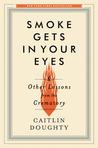
On Caitlin Doughty's Smoke Gets in Your Eyes and My Struggle with Mortality

Smoke Gets in Your Eyes: And Other Lessons from the CrematorySmoke Gets in Your Eyes: And Other Lessons from the Crematory by Caitlin Doughty

My rating: 5 of 5 stars


Amazing! Fascinating. Thought Provoking. Moving. And so very Necessary. I think the fact that it took me a couple of weeks to even get up the courage and watch an Ask a Mortician Youtube video says a lot about how much I needed this book.

I vividly remember the very moment I realized that we are all gonna die some day and how I immediatly wished to unknow this again. Of course this is the kind of thing you can never unknow again. And thus I have been struggling with mortality ever since my kindergarten days - having panic attacks on a semi-regular basis. And I waited for a good day – a day I would be able to handle these videos without plunging into another panic attack. I need not have been so worried. In fact, I could have spared myself a lot of anguish had I just gotten up the courage to look sooner. Because as it turns out the only thing that really helps with the things that you can not unknow is to know more.

And yet the approach the western world in general and - as Caitlin Doughty illustrates - america in particular takes is quite the opposite. We do everything in our power to avoid any confrontation with death. We avoid talking about it as much as possible. We hide dead bodies off stage behind the curtain. We even try to find the “cure” for it. As a history student I am well aware how bizarre it is that I managed to be alive for almost 29 years without ever having seen a dead person – even though I have been to more funerals than weddings. But the thing is, in Germany, too, these things are more like memorials nowadays. There is no dead body at a funeral anymore – only a closed coffin or an urn. And nothing actually gets buried.

So death in effect has been reduced to the absence of a person in our lives as opposed to the absence of life in a body. Without this book it never would have occurred to me how much of a difference this little distinction makes. Now I see how grossly I have misinterpreted the myth of Orpheus and Eurydice and how much we have become like the petty gods of the Iliad. I am serious. When you really think about it you'll have to admit that people in modern western societies have a lot more in common with the gods in that story than with the humans. That is because we seem to think ourselves at least potentially immortal. So deeply are we in denial about our own mortality. Yet we still die. And every time we do we experience it as essentially unnatural. Death is not part of our life. It is a glitch. We don't see it as something that needs to be accepted, but as something that needs to be fixed.

Smoke Gets in Your Eyes is the account of Caitlin Doughty's own journey towards an understanding of death and how contemporary America and by extension western societies chose to deal with it. She shows how flawed and unhealthy these attitudes really are, how they evolved alongside the rise of the funeral industry and our euphoria in face of the great advances in public health and medicine, and how we would profit from a more realistic understanding of and engagement with death. I very am glad that I got to vicariously experience this journey through the guidance of her kind and witty words. I laughed and I cried (did not have a panic attack) and I think it is fair to say that this book changed my life.


View all my reviews

March 29, 2015

On Reading and Loving Amanda Palmer's The Art of Asking

The Art of Asking; or, How I Learned to Stop Worrying and Let People HelpThe Art of Asking; or, How I Learned to Stop Worrying and Let People Help by Amanda Palmer

My rating: 5 of 5 stars


I was already about a third of the way into this book when it suddenly occurred to me that something felt different. For the first time in months I was truly absorbed in a story. Not picking apart, dissecting and judging for once. My annoying little inner critic monster had gone off and left me alone for this ride. And damn, I had not known how much I needed that time apart. I am not exactly sure what Amanda did to make him leave us alone (he has not come back to tell me yet).

Maybe it was because it did not feel so much like I was reading, but more like I was listening … or having a conversation rather (totally talking back in my head) – a very intimate conversation. Yeah, Amanda does share a lot. So much, in fact, that I found myself somewhat hesitant to read on at times, feeling like I was prying. Surely this could not be meant for my eyes. After all, what did I really know about her when I picked up this book? I had seen the TED-Talk a while ago (liked it), had heard the story about how Neil Gaiman wrote the Ocean at the End of the Lane for his wife, Amanda – did not draw any connection – and seen the video of a reading she did at Google, which convinced me that I needed to read this book like yesterday.

So while she had crossed my path a couple of times before, she had remained a passerby in the street. Registered but not seen. Now, after reading the book, it feels somehow wrong to refer to her by her last name as I would usually do in a review. Not that I would presume to know much about her based on a few intimate details. But I think I got her point. That is what is important. It gives me hope for humanity when it often seems like people are just out to cut each other's throats and tear each other's eyes out.

Don't get me wrong. She does not exactly sugar coat things. More often than not, when she lets herself fall, someone does abuse her trust. But for everyone that does there are a hundred people that don't. They just tend to fade to the background when the crook takes center stage. Just like the trolls and the haters are always so much louder than everybody else. That does not mean that there aren't any kind and compassionate people or that they are outnumbered … they just tend to be a lot less aggressive. I will make a point of picking this book up whenever I lose my faith in humanity again. And this is just one insight this book has got to give. There are many more to be had, if you pay attention.

Keep in mind, though, that despite the ever dreadful how-statement in the title, this is not a self-help manual or an expose on business tactics. If you are looking for one of those things, you have got the wrong book. It is simply a memoir. One woman's perspective. Beautifully written, remarkably insightful and incredibly moving. Excuse my gushing. I will now proceed to nurse my massive book hangover by checking out her music and possibly also the infamous blog, trying not to feel like a creepy stalker person for doing so.


View all my reviews

July 29, 2014

On Harry's Last Stand and Insights where You Least Expect Them

Harry's Last Stand: How the World My Generation Built is Falling Down, and What We Can Do to Save ItHarry's Last Stand: How the World My Generation Built is Falling Down, and What We Can Do to Save It by Harry Leslie Smith

My rating: 4 of 5 stars


I must admit that when I first saw this book and it's title, I assumed this would be the usual rant us younger folk expect from the elderly - you know about how easy we have it and how lazy we are and yada yada yada. So I did not bother to look any further until I saw this interview with him that justkissmyfrog posted on her youtube channel.


He was nothing like I imagined him to be. He was funny, compassionate and still so in touch. Yeah, we do not really expect that from the elderly. And as with all generalizations it is obviously not true across the board. I am a little ashamed of my initial judgement. Especially with my background I should be more aware of prejudices. But alas I realized my mistake and turned to his book for more of what he had to say.

And boy did he have a lot to say and in such a charming manner. He really lived a remarkable live that would have been a shame to be lost to oblivion. But he has got a nobler reason for telling his story than fishing for compliments or sympathy. He uses it to illustrate a point about our current state of affairs and the course we are on - not just in Britain, but across the board.

I certainly recognized some of the issues to be akin to some here in Germany. But while I for the most part did share his opinion even before I picked up this book, I never thought to look at it from quite this angle. That did help untangle some of my jumbled thoughts and see the proverbial golden thread running through. So while he does not give easy answers - neither does he claim to - I do have a little more clarity and something to orient my decisions.

Of course, whenever these things sound simple and easy answers are thrown about, you are probably not seeing the whole picture. They are always more complicated and we should be aware of that lest we comply with rash actions or unfavorable agendas.

I suppose the best we can do is to raise awareness, to not forfeit our votes - even if just to delude the less well meaning ones, to try and do more good than harm to the world around us, and, last but not least, to sometimes look beyond our prejudices. We might just hit upon gold where we would least expect it.


View all my reviews

June 29, 2014

Me and Mrs. Dalloway

Mrs. DallowayMrs. Dalloway by Virginia Woolf

My rating: 3 of 5 stars


I have got to say up front that Mrs. Dalloway put me through the most difficult reading process I ever made it through (and I have read a lot of academic texts, Egyptian tomb inscriptions and stuff). That was not because it is a bad book. It is because Mrs. Dalloway is not so much a book in the conventional sense with plot and such. It is basically a herd of consciousnesses invading your mind and running rampant. It is often hard to follow whose head you just switched into. It is somewhat like what I imagine being a mind reader must feel like. It's so utterly exhausting; like you wouldn't believe. I had to stop and take a break about every 30 pages and re-motivate myself to move on.

But while it was painful and hard to get through, it was also very rewarding and worth the effort in the end. It is hard to believe that this was first published in 1925. I mean, for example, how could this women so accurately (from what I understand at least) describe PTSD and recognize it as the serious illness that it is - long before it even became a diagnosis? And how come that it took the medical community so much longer to come to that same conclusion? (Their arrogance again and again their stupid arrogance. Like Woolf rightly recognized. And most infuriatingly still, they just don't learn from that mistake ever, it seems. Not from this. Not from the whole “gentlemen's-hands” debacle. Never. But I digress.)

All that would have been remarkable enough on it's own, but that is actually not the only issue she is surprisingly spot on about – again especially considering when this was written. She manages to step into the heads of all these characters and accurately portray them; young and old, male and female, everyone unique and life-like (i.e. with real issues); it's baffling. It makes me wonder if my paranoia about some people maybe being able to read my thoughts might have been justified after all …


View all my reviews

January 20, 2014

On Why Hogwarts is a Terrible School

So I've just read the Harry Potter Books ... for the first time. It's 2014. I know I've been late to the party - as usual. I had my reasons. Anyway, now that I've read the books, liked them and look at the fandom, I kind of wonder ... am I the only person who wouldn't want to go to Hogwarts?

I just don't think it would be such a nice place to be if one actually went there. For one thing, there is the division into different houses. What does that do, besides creating animosity - especially since they have them competing against each other for the House and Quidditch Cup. I guess some would argue that shared goals and responsibilities make the students within every one house bond and look after one another. But we see in the books that it doesn't work quite like that - as was to be expected. Because, you see, when somebody messes up and jeopardizes the victory they're gonna have a pretty hard time in their own house. And inter-house friendships prove to be rather difficult to maintain, since there hardly is any neutral place to hang out. You're likely not going to sit with people from other houses during meals. You can hardly have a conversation in the library. And besides that, where in the castle could people from different houses hang out? You're left with the grounds or the toilets, maybe the Room of Requirement.

And this is, I think, where the crux of the matter lies. You're not really supposed to mingle. The division of the houses is really sort of a divide and conquer strategy. One that has clearly gotten out of hand, since the teachers are as invested in the rivalry as the students are and even the parents. Because to many parents it is very important that their children end up in the "right" house - as illustrated by Sirius Black. And though the Weasley's wouldn't have been quite as harsh as that, had any one of the kids ended up in a different house, it would have surely impacted his status in the family. Because this isn't just about where you're dormitory is, it's basically a stigma. If you end up in Slytherin, people from other houses are going to assume that you're a criminal in the making. And people from your own house are going to make sure that your believes line up, if they don't already do. I think this system was largely responsible for the failure of Snape and Lily's friendship and why he ultimately ended up with the Death Eaters.

The other things that really bothers me about Hogwarts are the curriculum and the teaching methods. I find the curriculum rather narrow. It's almost entirely devoted to the use of magic (or magical creatures and substances), whereas the questions of understanding magic, ones own origins or the world at large hardly get touched - even in such subjects as History of Magic, Care of Magical Creatures and Muggle Studies. Neither seems critical reasoning much encouraged. It is not surprising therefore that even "good" wizards such as Ron hold some rather alarming believes and attitudes. And that despite the fact that most wizards have Muggle relations, not even the people from the ministry's Muggle related departments understand the most fundamental things about them or other magical creatures for that matter.

In general there seems to be hardly anyone concerned about ethics. The teachers only make their students brew the potions, practice the charms and what not. They hardly provide any context or caution. The best wizard according to Hogwarts standards is the one who can use magic to the greatest extent and in the most complicated ways - not the one who uses it most wisely. There is no real discourse on the line between use and abuse, which also makes the subject of Defence Against the Dark Arts hard to define, since the Dark Arts themselves are kind of a wishy-washy concept. There is some general idea that they are magical implements that are clearly intended to be used to somebody's disadvantage. But that could be said about most magical practice. And it is clear that even the unforgivable curses are not exclusively used by bad people. Hell, Harry himself uses two of the three.

Then there are the teaching methods. In general Hogwarts seems to operate under the false assumption that when you are good at something you are also good at teaching it. That is obviously not the case as nicely illustrated by Professor Binns, who holds his History of Magic monologues barely even aware of the students' presence, as well as Snape, who just writes the potions recipes on the blackboard and makes them hand in the results at the end of each lesson. And the essays they have to do for almost every subject are usually not more than senseless occupational therapy. Though, to be fair, on that particular account Hogwarts probably doesn't differ all that much from regular schools, but for the fact that the essays are for the most part mere practical recitations of the how-to-variety rather than critical reflections. The other very Hogwarts-specific problem is that the teachers - especially the heads of houses - have got an underlying agenda and hardly even make a show of treating students equally fair to put it mildly.

All in all I think Hogwarts, though certainly a fascinating place, is not a great environment if your ambition is to become a well educated and responsible wizard. In a way it is like our schools on steroids, but we at least get taught where we come from and how we work - usually that is.

November 18, 2013

On The Manic Pixie Dream Girl Trope and Paper Towns

Paper TownsPaper Towns by John Green

My rating: 4 of 5 stars


I've heard quite a few people criticize Paper Towns for being the cliche manic pixie dream girl story. Having read it myself, that kind of makes me wonder … have we read the same book? I mean, of course it is all ABOUT the manic pixie dream girl trope, since the whole thing is an attempt do discredit this trope. And Green could hardly have been more obvious about it. If anything, I would criticize him for this obviousness. That's somewhat of a reoccurring theme of his (among others). And it might stem from crafting a novel around a concept or idea – like fables or fairy tales – rather than letting the story evolve from the characters. But lots of people do this, and you can usually tell. It's a matter of personal preference whether one likes one or the other approach better. I personally enjoy both kinds of stories.

The most interesting thing about his endeavor is the approach Green took to attack the trope. He could have done it in loads of different ways. But he chose to basically build Margo up as a manic pixie dream girl, only to reveal in the end that it's all just been in Q's head. I think that's why a very cursory reader might mistake this for the actual trope. And in fact, one might wonder what the big difference is? Because that sounds like she basically serves the same purpose that every manic pixie dream girl does: helping “broodingly soulful” Q learn a life lesson that is going to be key to finding his own happiness. Now how's that for a conundrum? A manic pixie dream girl dispelling the myth of the manic pixie dream girl. Except, that's not quiet it, because unlike other manic pixie dream girls, Margo also learns a valuable lesson from the whole fiasco.

I think there is a rather strong indication – indication as in Green spells it right out (That's the obviousness I've been talking about.) - that Margo herself is initially somewhat infatuated with the idea of being someone's muse or manic pixie dream girl. And she initially sets herself up as one. She makes an effort to plant the idea in Q's head, and thinks the thing is done. She thinks she did something to effect an important change in someone's life, meaning that by extension she herself was important in this life she left behind – something she's been doubting for obvious (again) reasons.

What she doesn't reckon with, is how this idea evolves inside Q's head, leading him to recreate her into this larger than life “precious thing” that he needs to save, effectively making him her hero. So essentially they both want the same thing. And that's a problem. Because in order for one of them to be the hero and safe the other, one of them will have to be the damsel in distress. Neither of them identifies as such.

So when they finally meet again, they're both confronted with the implications of what they attempted to create. They learn to see each other as real life people rather than mere tropes and means to an end. And they both realize – Margo a little sooner than Q actually – that a muse or manic pixie dream girl is not what an actual person is, but merely the two dimensional unattainable thing another person makes them out to be – unattainable because real people in all their complexity can never achieve the level of simplicity a fantasy needs to be unambiguously positive.


View all my reviews

September 19, 2013

On The Fault in Our Stars and False Beliefs About An Author's Authority

The Fault in Our StarsThe Fault in Our Stars by John Green

My rating: 4 of 5 stars


I was a bit wary at first, because, you know, cancer book usually equals depressing and/or preaching. But no, this is definitely not your typical cancer book. Thank god for someone who doesn't use a serious illness to show healthy people the worth of their lives and yada yada yada. And though it is sad, it's not as depressing as one might expect from a cancer book. As usual John Green's wit serves to lighten the mood – even if that means that his characters sometimes sound a lot like him. What I love most about his books, though, is that they always give me something to think about. And because of that I will readily forgive him all of his minor short comings.

What kept me thinking long after I read this particular book was the question about whether or not authors are the one and only authority to their books. In the book Van Houten clearly holds the opinion – as does John Green – that the text is the authority and it's readers are free to interpret or build on it. There are, however, authors who would beg to disagree. (I won't name any names, but I hazard the authors who won't have you write any fan fiction of their works are some likely candidates.)

My stance is that fictional stories are ideas, and – even though copyright law might disagree with me there – ideas are not property per se. They didn't use to be thus and neither should they be. Of course you can't copy and paste, but you should be able to think and build on ideas. I admit that it is difficult to draw the line, but the way today's copyright law draws it is just beyond ridiculous. Re-imaginations, recreations and reincarnations are the surest ways for ideas to survive in posterity and that is what we risk losing.

But this wasn't supposed to be about the can of worms that is copyright law. The question is whether or not what the author imagines outside or even inside the text does have any more weight than what you would. And I'm with John and Van Houten on this one. It doesn't. You might read things into the story that the author didn't intend or the ending of a book disappoints you, and you decide to pretend it never happened or come up with a different one instead. By all means, knock yourself out.

You shouldn't view books and stories as holy scripture and the author their prophet, because conversations have much more creative potential than lectures. And though even authors themselves might confuse authorship with dictatorship, that doesn't make it any more right. Thinking for yourself is a skill that needs to be cultivated – as it should be, otherwise you'll be much too susceptible to manipulation. So yeah, you should go ahead and make reading your own experience. Let creativity bloom - even if it is in opposition. Posterity might just thank you for it.


View all my reviews

September 13, 2013

On the Lack of Romance and Lots of Selfish Belief in the Letters of Abelard and Heloise

Letters of Abelard and HeloiseLetters of Abelard and Heloise by Pierre Bayle

My rating: 4 of 5 stars


I must say that these letters were not quite what I had expected. That was because Abelard and Heloise didn't exactly live up to their reputation. I'm not sure how they ever ended up on the most-romantic-tragic-love-story-list. Don't get me wrong, I found the letters to be profoundly interesting on many different levels. A treasure for historians. Interesting character studies. But romantic? Not so much.

Abelard strikes me as too much of a narcissist to raise much sympathy for his misfortunes – especially since he basically does everything in his power to turn everyone against him. And the sad thing is, he doesn't even notice it – because he's just too damn full of himself. Lot's of self serving bias going on in there, I'd say.

And what about Heloise? Well, I've got a little more sympathy for her and her situation. What I find strange though – and maybe that's just my modern mind - is that among all those lamentations neither of them writes a single word of their offspring? All they talk about is themselves and their miserable lots. And that brings me right to the topic of their faith. You don't need to read much between the lines to notice that their so called piety and religious career, if you will, is a purely selfish endeavor. There's none of the nobler motivations. No ambition to make the world a better place and what not. All those I could tolerate within the proper framework – even as an atheist. For them, though, religion is but a means to an end. And I'm quite repulsed by that.

What strikes me as very ironic is that they feel oh so bad about having chosen their paths for the wrong reasons and about their lingering love for each other. So they apparently come to the conclusion that they should embrace their roles and try harder in order to – here it comes – receive absolution and save their own souls. They don't even seem to grasp the fact that this very foundation of their belief essentially turns everything they do into a selfish act. Yeah, they probably should feel bad, but they do so for all the wrong reasons. And the saddest part is Abelard's self-righteous attitude that people like him so often tend to display.


View all my reviews

August 29, 2013

On Monstrosity, Talent, and Perceptions of Reward and Punishment in The Phantom of the Opera

The Phantom of the OperaThe Phantom of the Opera by Gaston Leroux

My rating: 4 of 5 stars


I must say that with all the names being thrown around right from the beginning and the references to the complicated architecture of opera house I was very confused at first. That, however, got a lot better with the progression of the story and long after I was finished, I found myself pondering the implication that monsters may or may not be born to look the part, but ultimately made by humans/society.

I've never thought about this much before and it certainly awoke a whole new sympathy for Grendel. Did they – the phantom and Beowulf's Grendel that is – really have a choice or where they rather forced into the role of the monster by society. And if so, who is worse – they for embracing it or us for forcing this role upon them?

What's also interesting is that negative roles seem to be more reenforced than positive ones. While negative aspects like a monstrous appearance are likely to be found indicative of a person's character, positive ones like talents are often attributed to an external force. Take Christine for example. She and the Angel of Music where somewhat reminiscent of Dumbo and his feather. Like Dumbo even she herself didn't belief in her own abilities. Now, that might be good to keep a person humble and prevent them from becoming a megalomaniac or narcissist, but the underlying concept does have a serious downside.

What it comes down to is reward and punishment. Christine's talent is believed to be a reward for being good and working really hard, while the phantom's appearance is considered a punishment for being bad. The difference being that the reward is given after she put up a lot of effort, whereas the phantom's supposed punishment is received at birth. What horrible crime could he have committed in his mother's womb to deserve this? Sabotage a brother that we never heard of in a less ambivalent fashion than the biblical Jacob? Or do we believe in past lives here? And why is this punishment so permanent, when the rewards are so fleeting? Or are they fleeting because their source is corrupted?

Like Dumbo Christine only believes that she needs the Angel of Music to shine, while all she needs is really within her. And what she thought to be the Angel of Music is actually nothing of the sort, but a hoax. However, the demystification doesn't lead to her believing more in herself like it does with Dumbo. Instead it seems to make her lose her passion for music, because it now evokes negative associations – like the things linked to your psychopathic stalker will naturally do. Now, to sum this up, a book that gives you so much to think about is always well worth a read.


View all my reviews

August 16, 2013

Shakespeare’s Midsummer Night's Dream and the Dynamics of Female Friendships

A Midsummer Night's DreamA Midsummer Night's Dream by William Shakespeare

My rating: 5 of 5 stars


I absolutely adore this play! It's fun, it's got romance and magic and lots of wisdom. But the best thing about it is that amidst all the magic and strangely bewitching scenery there are - even roughly 400 years after it's creation - certain aspects that are still very relevant today.

The one that stood out to me – at least in this latest reading - was the relationship between Helena and Hermia, who have the kind of friendship or rather 'frenemyship' that sadly still seems to be the predominant kind of relationship between female friends. That they are more frenemies than friends is rather obvious right from their very first encounter in the play, wherein Hermia claims to be totally blameless in attracting Demetrius attentions. Yet, when the tables are turned, she immediately accuses Helena of having bewitched Lysander.

O me! you juggler! you cankerblossom!
    You thief of love! What! have you come by night,
    And stol'n my love's heart from him?
(III.ii.282-284)

This is a common phenomenon that I never quite understood: that somehow when a man is unfaithful, the other woman gets much more of the blame than the guy does. The justifications for this all seem to lead to the implication that men are driven by their needs and women are responsible for enticing them - however intentional or unintentional that might be. What is really sad about this is that this kind of rational - that also leads to victim blaming in cases of rape - is so widely propagated and accepted by women.

But turning back to the play, we can see how this dynamic comes about. Notice how Hermia becomes increasingly insecure about her appearance as soon as Lysander's change of heart dawns on her.

And are you grown so high in his esteem
    Because I am so dwarfish and so low?
(III.ii.294-295)

This is a telling indication that Hermia is a woman, who measures her own self-worth via external reassurance – especially but not exclusively through male attention. She then turns right around to direct her attacks on Helena. This is because when women define their self-worth like Hermia does, every other woman is essentially a rival and a threat – even and most especially their female friends. This unfortunately doesn't only make Hermia a sad and tragic figure, but also someone with whom meaningful friendship and solidarity are just not possible.

Helena, on the other hand, did handle the same situation in a much different way. She, unlike Hermia, didn't become insecure about her appearance.

Through Athens I am thought as fair as she.
    But what of that? Demetrius thinks not so;
    He will not know what all but he do know.
(I.i.227-229)

She also didn't blame Hermia for his change of heart, but Demetrius himself, and was frustrated with her own still lasting obsession with him. She - instead of attacking Hermia - sought her advise, thinking that Demetrius might love her again, if she could just be more like Hermia. The latter, however, in correspondence with her understanding of self-worth misinterprets this as an attack.

His folly, Helena, is no fault of mine. (I.i.200)

She is just too preoccupied with the reassurance of her own self-worth to even manage unimpaired communication with her friend.


View all my reviews